

×

Compare Generative AI Tools and Check Appropriate Data Levels

close up photo of hands working at a laptop propped up on textbooks

The below table shows Generative AI tools currently available from the Office of Technology Services, including the level of confidential Lone Star College data for which these tools are approved.

Many other AI tools are available to the public, including tools that are free to use. However, per Lone Star College guidelines, you should not enter data classified as Confidential or Restricted into publicly-available Generative AI tools.

As always, if you’re considering using Generative AI tools for Lone Star College work, you must follow the College's initial guidelines for use.

Generative AI Tool Comparison

Tool Overview Availability Data Classification Level
Copilot for Microsoft 365 AI assistant integrated into Microsoft 365 apps.

Features: Creative writing, Data analysis, Image generation, Summarizing, Text generation and editing, Translation
Currently in testing Low - Medium

Adobe Firefly

and

Adobe Express

Generate images and text effects by simply typing key words or a description. Trained on stock images, openly licensed and public domain content. Also integrated into Adobe apps.

Features: Image generation, Image editing
Available to Lone Star College students (in select courses), faculty, and staff as part of LSC's Adobe Creative Cloud license. Low - Medium
Canva for Education

Free, easy-to-use, and engaging tools for students, faculty, and staff to create and share posters, videos, infographics, and more.

Features: Image generation, Stock art, Video generation, templates for a variety of mediums

Available to Lone Star College students, faculty, and staff as part of LSC's Adobe Creative Cloud license. Low - Medium
OpenAI ChatGPT Chatbot able to generate text, code, images, and more.

Features: Chatbot customization, Code generation, Creative writing, Data analysis, Image generation, Summarizing, Text generation and editing, Translation
NOT approved for internal usage  
Claude.ai

AI assistant focused on safety, reasoning, and high-quality text generation.

Features: Advanced writing and analysis, Long-context processing, Code generation, Document summarizing, Research assistance, Text editing, Translation, Data interpretation, Chatbot customization.

NOT approved for internal usage  


Lone Star College Data Classifications
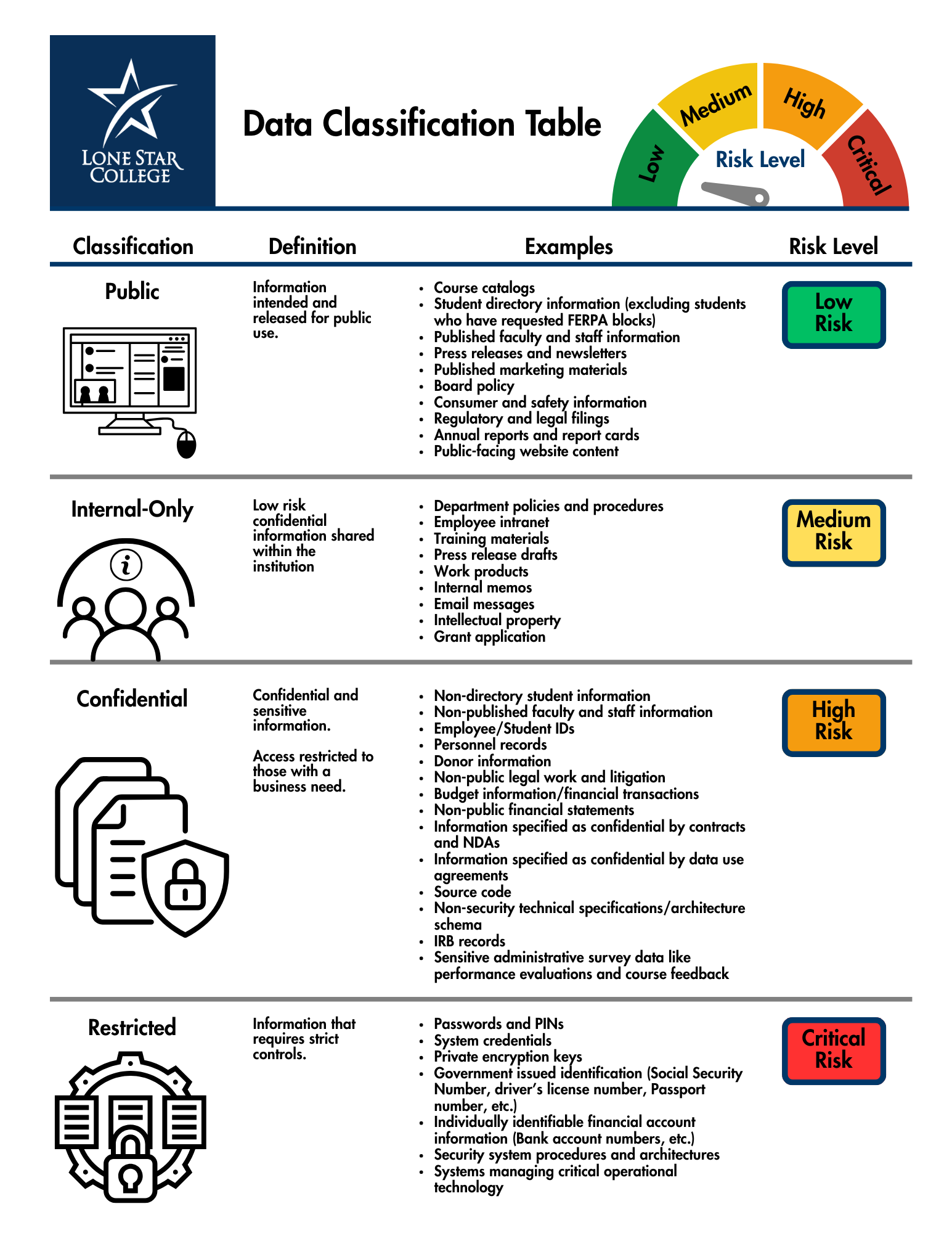
A four-column data classification table outlining risk levels, definitions, and examples for different types of institutional information. The columns are labeled Public, Internal-Only, Confidential, and Restricted, progressing from low to critical risk.  Public (Low Risk): Information intended and approved for public use. Examples include course catalogs, student directory information (excluding FERPA-blocked records), published faculty and staff information, press releases, newsletters, marketing materials, board policy, consumer and safety information, regulatory filings, annual reports, and public-facing website content.  Internal-Only (Medium Risk): Low-risk confidential information meant to be shared only within the institution. Examples include department policies and procedures, employee intranet content, training materials, draft press releases, work products, internal memos, email messages, intellectual property, and grant applications.  Confidential (High Risk): Sensitive information restricted to individuals with a business need. Examples include non-directory student information, non-published faculty/staff information, employee or student IDs, personnel records, donor information, non-public legal or financial documents, confidential contract or data-use agreement information, source code, technical specifications, IRB records, and sensitive survey data like evaluations.  Restricted (Critical Risk): Information requiring the highest level of control. Examples include passwords, PINs, system credentials, private encryption keys, government-issued identification numbers, financial account information, security system procedures, and systems managing critical operational technology.


Make LSC part of your story.